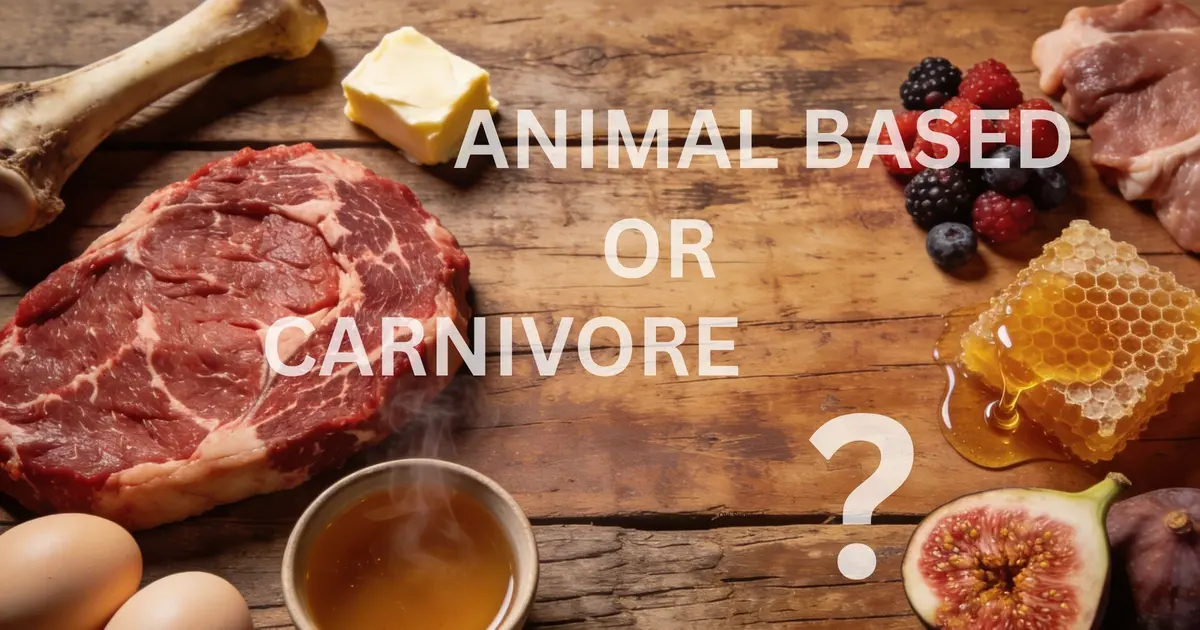
If you've spent any time in carnivore or ancestral health communities recently, you've noticed something: the conversation has split. There's carnivore — meat, fish, eggs and animal fats (dairy varies), all animal foods, nothing from the plant kingdom — and there's the animal-based diet, which shares that animal-food foundation but adds fruit and honey as acceptable carbohydrate sources. Within carnivore itself, there's also the lion diet at the strictest end: beef, salt, water only.
What Is the Animal-Based Diet?
The animal-based diet is an eating pattern built mainly around animal foods (meat, fish, eggs, organs and animal fats) that may also include some fruit, honey or other plant foods, depending on who is describing it. Definitions vary between communities, and there is no single official standard. The term is most often traced to Dr. Paul Saladino, who set out his version in The Carnivore Code (2020), although the wider meat-centred movement is older than the label. Carnivore keeps the same animal-food foundation and leaves the plant foods out. Published research on either pattern is limited; one 2021 survey of 2,029 adults following a carnivore diet was self-reported rather than clinical (Lennerz et al.).
Carnivore and animal-based both have vocal advocates and growing communities. And if you spend enough time in either community, you'll encounter people who treat the other approach with deep suspicion.
This article isn't going to take sides. What it will do is explain both approaches clearly, describe what tracking looks like for each, and make the case for why your own data is ultimately more useful than anyone else's rules.
Carnivore: What It Actually Means
The carnivore diet in its strictest form is exactly what it sounds like: eat only animal-sourced foods. Meat, fish, eggs, animal fats. Nothing from the plant kingdom. No fruit, no vegetables, no grains, no legumes, no nuts, no seeds, no plant-based oils.
In practice, most people following a carnivore approach exist on a spectrum:
Strict or "lion diet" carnivore: Beef, salt, water only. Sometimes eggs included. This is the most restrictive version, often used as a short-term elimination baseline by people who want the cleanest possible starting point. It is a community practice rather than a clinical protocol.
Standard carnivore: All meats, fish, eggs, animal fats. Salt. Some practitioners include dairy; others exclude it during an initial elimination phase and reintroduce it systematically.
Nose-to-tail carnivore: Emphasis on organ meats — liver, heart, kidney, bone marrow — as nutritional cornerstones alongside muscle meat. Advocates often describe it as the most nutrient-dense version of the diet.
Ketovore / keto-carnivore: Primarily animal foods, but carbohydrates are tracked and kept low rather than eliminated entirely. May include some low-carb plant foods. The crossover between strict keto and carnivore.
What unites all versions: the removal of plant foods as the primary dietary change, and the reliance on animal proteins and fats as the nutritional foundation.
Animal-Based: What It Actually Means
"Animal-based" emerged primarily through the work of Dr. Paul Saladino, who popularised the concept of building a diet around animal foods while incorporating certain plant foods — specifically fruit, honey, and raw dairy — that proponents describe as lower in plant defence compounds (such as lectins and phytates) than most plant foods.
The core logic: if the concern with plant foods is their antinutrient content and potential inflammatory effects, then some plant foods are more problematic than others. Proponents argue that fruit is lower in lectins than grains, that honey is simpler in its sugar composition than processed sweeteners, and that raw dairy preserves enzymes that pasteurisation destroys. These are claims made within the animal-based community rather than settled findings.
Animal-Based Diet Food List
What animal-based typically includes:
- Muscle meat and organs (similar to carnivore)
- Fruit — particularly tropical fruits and berries
- Raw honey
- Raw dairy (raw milk, raw cheese, raw butter) — emphasised over pasteurised
- Eggs
- Animal fats
What animal-based typically excludes or minimises:
- Grains, legumes, and seed oils (consistent with carnivore)
- Vegetables, nuts and seeds that advocates consider high in oxalates or lectins (spinach, kale, nuts, seeds)
- Processed foods
The difference from strict carnivore is the inclusion of plant foods that animal-based advocates consider better tolerated — primarily fruit and honey — as carbohydrate sources, alongside a strong emphasis on organ meats and raw animal products.
Where the Communities Collide
The friction between carnivore and animal-based communities usually comes down to two questions: whether fruit raises insulin in a problematic way, and whether "no plants" is a necessary rule or an unnecessarily strict elimination.
Strict carnivore advocates argue that any plant food carries risk for sensitive individuals, that carbohydrates from fruit are metabolically unnecessary, and that the strictest elimination produces the cleanest data.
Animal-based advocates argue that whole fruit is not metabolically equivalent to processed sugar, that certain nutrients in fruit and raw honey complement an animal-food diet, and that rigid rules remove foods that many people tolerate well.
Both positions have genuine arguments behind them. And here's the thing: for any given individual, only their own body's data can settle the question. There is no universal answer. The person who thrives on fruit alongside their animal foods is not wrong. The person for whom fruit derails their inflammatory symptoms is not wrong either. They're just different bodies with different responses.
This is precisely why tracking matters more than doctrine.
What Tracking Looks Like for Each Approach
Tracking Strict Carnivore
Strict carnivore tracking is in some ways the simplest version — the food variables are minimal, which makes pattern detection cleaner. The main tracking dimensions:
Food detail that matters:
- Protein source and cut (important — different proteins have different effects for sensitive individuals)
- Fat content and type (grass-fed vs. grain-fed, rendered tallow vs. butter, fatty cuts vs. lean)
- Histamine load (fresh vs. aged or stored; histamine can rise with storage and fermentation, and cooking method matters — grilling or other dry heat can raise it, while boiling may lower it; some people who suspect histamine sensitivity log this)
- Organ meat frequency (some people report that liver affects their energy or skin)
- Dairy inclusion or exclusion
If you want the full list of what goes in a strict baseline, see the carnivore elimination diet guide and food list.
Symptoms to watch: Energy, skin, gut, cognitive clarity, joint stiffness, sleep quality. With strict carnivore, the food variable space is narrow enough that symptoms can be easier to line up with specific protein choices — which is the point of the strict approach.
Tracking Animal-Based
Animal-based tracking has more variables, which makes the data richer but the patterns slightly harder to isolate:
Additional food variables vs. strict carnivore:
- Fruit type and quantity (fructose load varies significantly — a few berries versus a large fruit salad are different metabolic events)
- Honey quantity and timing (raw honey affects blood glucose differently than no carbohydrate)
- Raw vs. pasteurised dairy (advocates treat them as different foods; note that the US FDA warns raw milk and foods made with it may be harmful, with higher risk for pregnant people, young children, older adults and people with weakened immune systems, so talk to your clinician before adding it)
The value of tracking for animal-based specifically: Many people transition to animal-based from strict carnivore because they want to reintroduce some plant foods. Without tracking, the reintroduction is guesswork. With tracking, you build the data to know exactly how your body responds to fruit, to honey, to raw dairy — individually and in combination.
If your skin improves on strict carnivore but you want to reintroduce mango — track it. A commonly suggested approach is to eat it consistently for a week or two (this is a conservative community approach, not a clinical standard, and a clinician can tailor it to you). Log your skin condition, your energy, your gut every day. The data tells you whether mango is a problem for you. That answer belongs to you, not to either community's doctrine.
Both Approaches Work Better With the Same Tracking Framework
Regardless of where you sit on the carnivore-to-animal-based spectrum, the tracking structure is identical:
Daily logs:
- Every food consumed, with protein source, cut, quantity, and cooking method
- Symptom severity for your primary concern (skin, gut, energy, cognitive, joint) rated 1–10
- Energy levels morning, midday, evening
- Sleep quality and hours
- Stress level
- Any unusual exposures or variables
The delay window: Log every day and let the data bridge the gap between what you ate and when your body responded. Think of it as a filling glass: symptoms appear once the amount of a trigger you have taken in crosses your personal threshold, and two things set how fast that happens, how much of the food you eat and how sensitive you are to it. A large amount, or a high sensitivity, can cross the line after a single exposure, which can show up within hours to about 72 hours. A low-grade sensitivity, or small amounts eaten daily, may only cross it after a build-up of about 3 to 7 days of repeated exposure. It varies from person to person, and that gap is what makes food-symptom connections hard to see by memory alone.
Reintroduction data: If you're using an animal-based approach to systematically reintroduce foods after a carnivore baseline, your daily logs during reintroduction are your most valuable data. Commonly suggested: one food at a time, roughly 1–2 weeks of consistent exposure, daily symptom logging throughout. That timeframe is a conservative community approach, not a clinical standard, so check with your doctor if you have a diagnosed condition.
How to Tell Which Approach Suits You: Track It
You do not need to settle the carnivore versus animal-based argument to find out what suits you. You need a record. A simple daily log of what you ate, how your digestion, energy, sleep and skin felt, and when, lets you compare the two approaches (or one change at a time within either) using your own dates instead of your memory. Elimination followed by one-at-a-time reintroduction is a commonly used clinical approach for spotting food reactions, and it only works if you can line up what you ate against what happened afterwards (Katta & Schlichte 2014).
If you want a starting list of what to record, our guide to how to track symptoms on a carnivore diet walks through it. Our app lets you log all of this in one place and review it across days, with a 14-day free trial and no credit card required. If you have a diagnosed condition or take medication, keep your doctor in the loop before you change what you eat.
The Only Rule Worth Following
Both the carnivore and animal-based communities have something right and something slightly incomplete. Strict carnivore is right that a clean elimination baseline produces the clearest data. Animal-based is right that individual responses to plant foods vary enormously and that rules shouldn't be applied universally.
The resolution isn't a philosophical position. It's data.
Start with the cleanest baseline you can manage. Build enough consistent data to see patterns. Then test foods systematically and let your body's response — logged, timestamped, and reviewed across the days that follow — tell you what works for your unique physiology.
That answer will not be identical to Kristina's. Or Paul Saladino's. Or your carnivore Reddit community's. It will be yours.
Frequently Asked Questions
What is the animal-based diet?
It is an eating pattern built mainly around animal foods that may also include some fruit, honey or other plant foods. Definitions vary between communities, so check what a particular source means by the term.
Is animal-based the same as carnivore?
No. Both rest on an animal-food foundation. Carnivore leaves out plant foods, while animal-based commonly adds fruit and honey, and some versions include raw dairy. Where the line falls depends on who is describing it.
How do I know which one is working for me?
Neither approach is right for everyone. A dated log of what you eat and how you feel lets you compare your own results over time. If you have a medical condition or take medication, talk to your doctor before making changes.
References
- Lennerz BS, et al. 2021. "Behavioral characteristics and self-reported health status among 2,029 adults consuming a 'carnivore diet'." Curr Dev Nutr, 5(12):nzab133.
- Saladino P. 2020. The Carnivore Code. Houghton Mifflin Harcourt.
- Katta R, Schlichte M. 2014. "Diet and Dermatitis: Food Triggers." J Clin Aesthet Dermatol, 7(3):30–36.
- U.S. Food and Drug Administration. "The Dangers of Raw Milk: Unpasteurized Milk Can Pose a Serious Health Risk." fda.gov/food/buy-store-serve-safe-food/dangers-raw-milk-unpasteurized-milk-can-pose-serious-health-risk (page content current as of 30 May 2024; accessed 2026-11-10).
Medical disclaimer: This article is for educational purposes only and does not constitute medical advice. Always consult with a qualified healthcare professional before making significant dietary changes, particularly if you are managing a diagnosed medical condition, taking prescribed medication, or have a history of disordered eating. The carnivore or animal-based elimination approach involves significant dietary restriction — appropriate professional supervision is especially important for anyone with a history of nutritional deficiency, kidney disease, or cardiovascular conditions. Symptoms discussed in this article can have multiple causes, some of which require specific medical management. If you suspect a true food allergy (especially one causing severe or anaphylactic reactions), seek evaluation from a board-certified allergist. For pet dietary changes, always work alongside a qualified veterinarian.